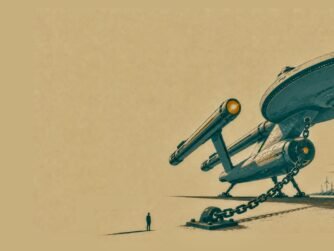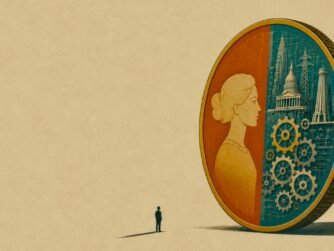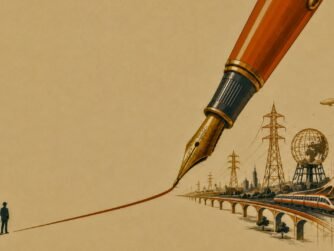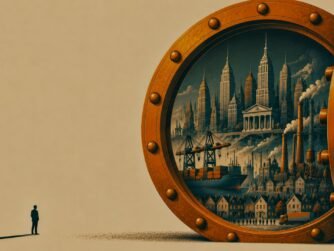





In 2024, global employee engagement fell to near-pandemic levels… without a pandemic. The crisis isn’t one thing, it’s everything, all colliding at once, and we have no framework for processing any of it.
—
Today, we’ll start in the workplace. As you might know, Gallup tracks employee engagement across the globe every year. In 2024, the “engaged” number fell from 23 % to 21%. That doesn’t sound particularly dramatic until you also know engagement has steadily, very slowly, but steadily increased over the past 12 years, but it’s only fallen twice. Once in 2020, the pandemic year, of course, but then it fell again in 2024.
I want us to ponder this for a moment, because it would seem that we are right now near pandemic level disengagement… without a pandemic. Without a lockdown, without ANY singular identifiable crisis event that everybody can point to and say, “That’s why.”
THIS is actually my point. There IS no singular problem.
What’s happening is that the walls between things are gone. The crisis isn’t a specific event. It’s lots of events colliding. It’s everywhere, but also kind of nowhere. This problem doesn’t have a name on the news or a headline in the papers. What we’re feeling is the weight of a world that won’t stop intersecting, but nobody’s given us the tools to process this kind of intersectional reality.
That’s the critical piece. It’s not just that the world is bleeding into the workplace or vice versa. It’s that we have no framework for the mind boggling number of intersections we’re currently experiencing. Our intuition is screaming that something has fundamentally shifted, but we were all trained for separation: neat categories, separate departments, clean columns.
So even though the signal comes through to our bodies loud and clear — “Something is weird!” — we also have absolutely no idea what to do with that. The pressure just accumulates below the surface in our emotions and in our spirits and in our bodies.
You feel it, right? The American Institute of Stress calls this ambient societal stress. Right now, this kind of stress is nearly impossible to escape. It’s really hard to manage because it’s tied to events that are outside of our control. Ambient societal stress? That definitely describes what I’m feeling most days.
To make this even worse, At work, most of us don’t get to put a clean label of “world events” on our stress. In too many of our workplaces, there’s still an implicit rule of keeping these things “separate,” right? “Ooh, don’t bring that stuff in here.” “It’s too polarizing, too difficult!” But we can’t NOT carry it with us. So at work, we just end up seeing SYMPTOMS.
Ambient societal stress at work shows up like distraction, or fatigue, or brain fog, or interpersonal tensions, or sometimes poor decision-making. I don’t want to make a comment here about “treating symptoms instead of the disease”… feels really cliche, but… I’m pretty sure this is what most of our workplaces are doing.
Neuroscience has a word for what’s happening underneath all of this: dysregulation. When our nervous system is constantly running a low-grade threat response, our executive functioning degrades. What does that mean? Creativity, collaboration, complex thinking, all of it takes a hit. This isn’t happening dramatically to all of us all the time, but it’s happening some of the time to enough of us to really matter.
Think about it this way: if we multiply the impacts of ambient societal stress across every person in your workforce, that’s no longer a small issue. That’s a really big performance problem.
I call this The Dysregulation Tax. This is a hidden toll on everything your organization is trying to do right now. It might show up as change initiatives that stall for no clear reason or talented people who are quietly disengaging or teams that just can’t seem to collaborate as well as they used to. You might also not actually see it at all, at least for a while, because this is the kind of problem that compounds beneath the surface until it breaks something BIG.
It’s “gradually, then suddenly.”
The dysregulation tax is particularly nefarious because it’s not even really allowed to be there. Most workplaces are still operating under the illusion that “separateness” is an actual thing that can happen, but it can’t. You can’t leave your body at home when you go to work. That feels absurd when I say it that way, but a lot of you listening to this know exactly what I’m talking about. Your full self isn’t totally welcome in your workplace.
There’s another problem here too, which is that organizations actually don’t WANT you to leave your body at home. Your emotions are the things that keep you plugged in to intrinsic motivation, which is what creates exceptional work. Your instincts are what help you make good decisions. Your humanness is what pushes you to go the extra mile for your customers. Your organization wants and needs all those things.
Do you see the problem more clearly now? We are deeply dysregulated for very healthy, sane reasons. But many of us spend huge parts of our day pretending that we’re “fine.” Your intuition is intelligent. That primal, pre-verbal, something’s-fundamentally-different sensation. That’s not a glitch in your nervous system. That’s ancient pattern recognition software doing what it was designed to do.
Humans have survived for millennia by sensing when the environment shifted before they could explain why it shifted. That capacity didn’t disappear just because now we make spreadsheets instead of spears. The problem is that these days, we’re not teaching each other how to trust our intuition or how to see the pattern it’s pointing at. We were never taught a framework for intersections. We were never trained for separation. “Work” in one box, “World” in another. So when everything starts colliding and converging, we don’t have a good way to make sense of it. We don’t have tools for that.
We just have this low-grade persistent sense that something has shifted. And especially at work, we have to feel it, but then have no space or venues in which to name what it is or do anything about it.
But if we take a little space and follow that feeling all the way down past the noise, past the anxiety, what we find underneath isn’t dread, it’s knowing. You know things are changing. And sure, maybe knowing is a different kind of scary, but it’s important to know we’re not crazy. The strangeness we’re sensing isn’t random. It’s not just too much news or too little sleep. It’s a pattern we’re all living inside. A measurable, repeatable, civilizational pattern that’s played out across centuries. Your gut and the history books are pointing at the exact same thing.
For most of the industrial era, separation was a powerful organizing principle of civilization. Work here, family there. Economy in one column, politics in another. World events? somewhere in the background… on the evening news, safely contained, one hour after dinner. Here’s what nobody says: those lines? They were never natural. They were engineered. Deliberately. Often by people who benefited from keeping the domains of human life siloed from each other.
Think about what separation actually accomplishes. If workers don’t see themselves as citizens, they’re easier to exploit. If citizens don’t see themselves as economic actors, they’re easier to manipulate. If your religious identity and your political identity and your work identity never touch each other, the people managing each of those spheres never have to answer to each other. Keep everything separate, each domain can run with no accountability from the others. Division is a fabulous “management” tool.
In this era, the CEO who polluted the river on Friday and donated to environmental causes on Sunday didn’t feel like a hypocrite because they could tell themselves they were a person navigating a world that was designed to keep those roles from confronting each other.
In this era, the politician who preached about family values and then voted against family leave benefits wasn’t confused because they could tell themselves they were just operating in a system built to keep personal values and policy in separate columns.
The separation was always a lie. We just feel it more now.
It turns out, the walls weren’t there just to keep things organized. The walls were also there to keep us from seeing how the system actually worked.
I think people have always sensed this to varying degrees, even when they couldn’t articulate it or speak up about it. That low grade feeling that something isn’t adding up, that the official story doesn’t quite match the experience… that’s intuition doing its job. The built walls suppressed that signal, they didn’t eliminate it.
But then came the internet, mobile, social media, A.I. Each of these technology waves didn’t just change how we work, they dissolved another wall. The news cycle became a 24-hour scroll on the same device you use for work email. Your online identity and your professional identity collapsed into the same LinkedIn profile. The “outside world” and the “inside world” became the same frickin’ world. There was simply no separation anymore. “Work-life balance?” Any of that that was still around expired mightily in 2020.
And our nervous systems, which were never built for this volume of ambient noise, well, they never got the memo to just stay professional about it. Evolutionarily, it’s not really a thing our nervous system does. Over the past few decades, people haven’t gotten softer, the walls have gotten thinner. And what was always true about how all the different parts of our world intersect have slowly become unavoidably visible.
Our intuition was right, it was always right. Now, we’ve just finally run out of walls for the truth to hide behind. What we’re living through right now has a name, even if most headlines haven’t found it yet. This is The Intersection Age. Everything is intersecting with everything else.
Economics bleeds into politics and politics bleeds into your industry and your industry bleeds into your talent market. Your talent market bleeds into your company culture. Your company culture bleeds into performance, performance bleeds into the stock price. Your stock price is then impacted by another war halfway around the world. There are no more clean separations. No story stays in its lane. There’s no “external” event that doesn’t eventually show up on your P&L as distraction, attrition, or resistance to change.
I know this feels chaotic and unprecedented, but while it may be chaotic, it’s not unprecedented.
History suggests this kind of moment has a clear pattern. Strauss and Howe called it The Fourth Turning. This isn’t the first time humanity has stood in this particular intersection. It happened in the 1930s and 40s when the wall between government and the economy collapsed and the New Deal rewrote their relationship. It happened in the 1860s when the wall between federal authority and states’ rights finally gave way. It happened in the 1770s when the walls of the monarchy crumbled and created the United States.
The pattern goes back centuries, and every time, I’m pretty sure, the people living through it felt exactly what you’re feeling now. They had a sense that something has fundamentally changed. They were right. And so are you. But remember, the people who survived those moments didn’t survive by trying to reinforce the old rules. They survived by building new structures capable of holding the new reality. That is the work in front of us.
And here’s what I really want you to hold onto: this season of crisis always ends. We are not in endless chaos. We are in transitional chaos. There’s a difference, and knowing that difference is itself an advantage.
So our Optimistic Rebellion is this: refuse to let the intersections be owned by the people who benefit from making them a mess. The industrial age was built on separation. The new reality will be about connection. The world doesn’t stop at the office door anymore. Your gut knew that before you had language for it. Now you have both. So let the world feel weird… but also, let that feeling push you into helping making the next world better.
Original post with all source links: https://joshallan.com/2026/03/31/stop-pretending-theres-no-geopolitics-in-your-workplace/